
-
High-frequency measurement system services Material testing Probe station Microwave anechoic chamber/shielded roomLan Cable Fully Automatic Tester Auto Switch fully automatic testing machine USB 4 / Type-C finished product line test system DisplayPort 2.1 finished product line test system HDMI 2.1 finished product line test system MCIO finished product line testing system Gen-Z finished product line testing system PCIE finished product line test system OCuLink Finished Product Line Test System QSFP/SFP finished product line test system HSD finished product line test system FAKRA finished product line testing system SAS/MiniSAS/SlimSAS Finished Product Line Testing System Raw Cable 20G/40G/50G Bare Wire Test System SATA/eSATA finished product line test system LVDS finished product line testing system Pre-test Integration ProjectElectromagnetic shielding test system Material electromagnetic parameter testing system Resistivity testing system Cable Shielding Effectiveness Test System Conductive gasket shielding effectiveness test system Reflection rate test system for absorbing materials NSS Noise Suppression/Absorption Sheet Performance Evaluation System Pre-compatibility testing systemUltra-low temperature vacuum probe station Automated probe station Manual probe station Displacement platform
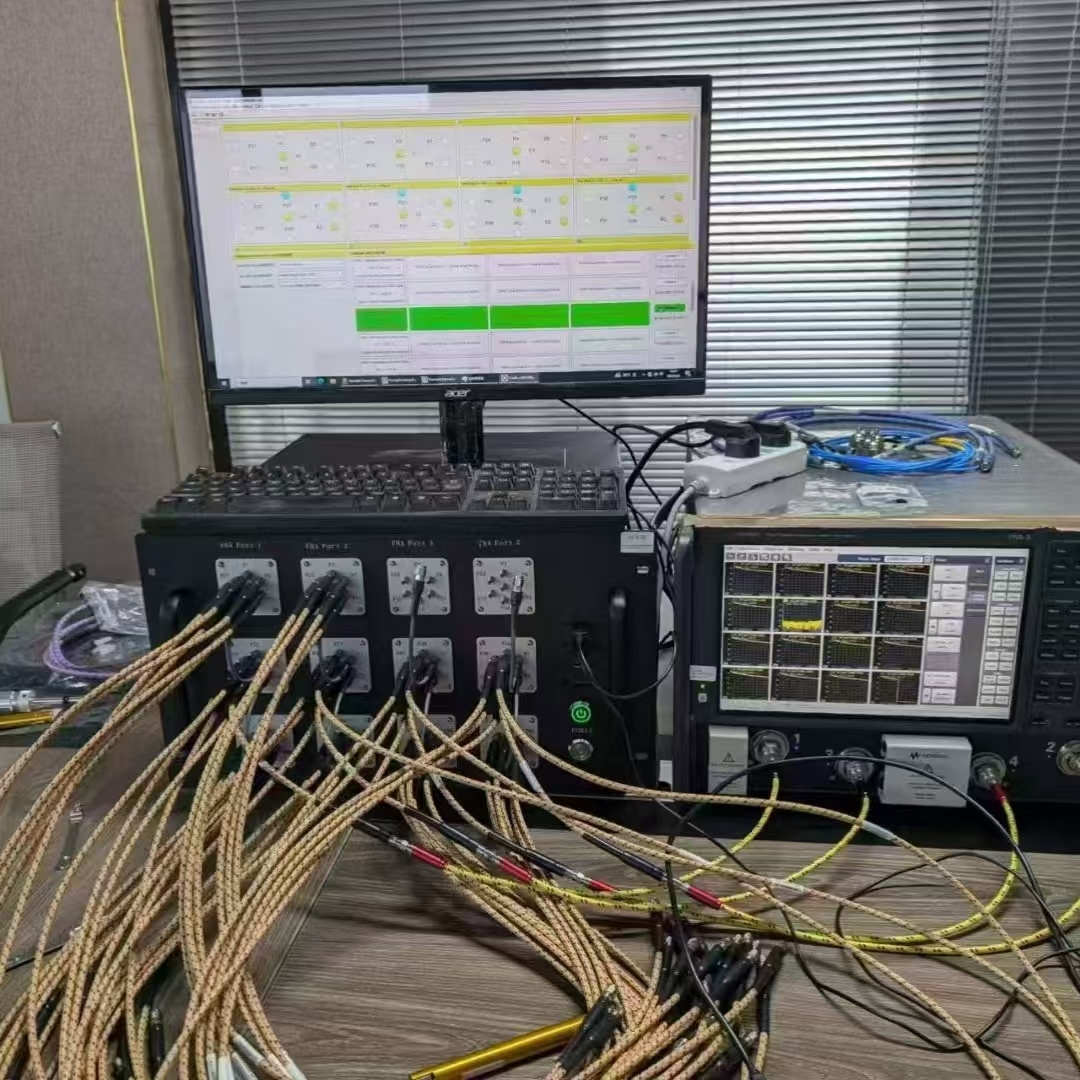


R&S®ZNB3004 Vector Network Analyzer 9 kHz to 4.5 GHz
Ultra-fast measurement cycles deliver excellent throughput. With frequency ranges of 9 kHz to 4.5 GHz, 9 GHz, 20 GHz, and 26.5 GHz, the R&S®ZNB3000 vector network analyzer is an ideal choice for communications and aerospace applications. The R&S®ZNB3000 excels and delivers optimal results in mass production environments for RF devices and applications with short rise times. The R&S®ZNB3000 features a flexible upgrade concept, allowing it to quickly scale up to meet various requirements. With fast measurement speeds, high stability, excellent RF performance, and multiple expansion functions, the R&S®ZNB3000 is well-suited for its tasks.
Category:
Desktop network analyzer
Product Attachment:
- Product Description
- Selection
-
- Commodity name: R&S®ZNB3004 Vector Network Analyzer 9 kHz to 4.5 GHz
Ultra-fast measurement cycles deliver excellent throughput. With frequency ranges of 9 kHz to 4.5 GHz, 9 GHz, 20 GHz, and 26.5 GHz, the R&S®ZNB3000 vector network analyzer is an ideal choice for communications and aerospace applications. The R&S®ZNB3000 excels and delivers optimal results in mass production environments for RF devices and applications with short rise times. The R&S®ZNB3000 features a flexible upgrade concept, allowing it to quickly scale up to meet various requirements. With fast measurement speeds, high stability, excellent RF performance, and multiple expansion functions, the R&S®ZNB3000 is well-suited for its tasks.
R&S®ZNB3020 Network Analyzer: All-in-one Solution for High-precision RF Testing
I. Product Overview
II. Core Technical Advantages
- Frequency Range : 100kHz to 20GHz, covering high-frequency applications such as 5G communication, satellite navigation, and radar systems
- Dynamic Range : 140dB (typical), capable of clearly capturing weak signals (e.g., -120dBm), suitable for precise characterization of low-loss devices (e.g., filters, antennas)
- Temperature Stability : 0.01dB/°C, ensuring consistency during long-term testing and reducing environmental interference
- built-in intermodulation wizard : Supports odd-order intermodulation product measurements such as third-order and fifth-order, with one-click test report generation
- Four-port Design : Integrates two independent signal sources, eliminating the need for an external combiner, reducing measurement time by 10 times
- Real-time Spectrum Analysis : Simultaneously displays fundamental and intermodulation products, quickly pinpointing non-linear distortion issues
- 12.1-inch Touchscreen : Intuitive graphical interface, supporting drag-and-drop parameter settings
- Virtual Network Embedding : Quickly de-embeds fixture effects, simplifying testing procedures for complex structures (e.g., PCB boards)
- Multi-port Expansion : Expandable to 48 ports via switch matrix, meeting the testing requirements for large-scale MIMO arrays
III. Typical Application Scenarios
- Amplifiers : Power sweep (98dB range) and gain compression testing
- Mixers : Conversion loss, isolation, and harmonic suppression analysis
- Filters : Group delay, in-band ripple, and out-of-band suppression measurements
- 5G Base Stations : PA linearity, antenna array calibration
- Satellite Communication : Performance evaluation of millimeter-wave components (e.g., frequency multipliers, phase shifters)
- IoT Devices : RF consistency testing of NB-IoT modules
- Segmented Scan : Completes 401 points test in 4ms, increasing throughput by 30%_
- Automated Calibration : Completes TSM calibration in 30 seconds, reducing human error
IV. Technical Parameter Comparison
V. User Value and Industry Recognition
- Improve R&D Efficiency : After adopting ZNB3020, a 5G chip manufacturer shortened PA linearity test cycles by 40%_
- Reduce Production Costs : With built-in calibration tools, a filter production line saved over 500,000 RMB in annual calibration costs
- Industry Certifications : Supports standards such as MIL-STD-810H, IEC 61326, suitable for harsh environments like aerospace and military industries
-
I. Hardware Options
- Function Compliant with IEEE 370 standard, it supports automatic removal of the test fixture's influence from the Device Under Test (DUT) data, suitable for PCB board-level testing.
- Order Number 1328.8611.02
- Application Scenarios Precise measurement of high-frequency components (such as filters, amplifiers).
- Function Automatic calibration of the test fixture through the fixture database, reducing manual calibration time.
- Order Number 1328.8628.02
- Application Scenarios Scenarios with frequent fixture changes in mass production environments.
- Function Developed in cooperation with the Swiss Federal Office of Metrology (METAS), it automatically calculates the measurement uncertainty range and displays it synchronously with the S-parameters.
- Order Number 3644.5977.02
- Dependencies Requires METAS's "VNA Tool" software.
- Function Expands the power scan range and improves the dynamic range of amplifier measurements.
- Typical Parameters Attenuation range 0-70 dB, applicable to ports 3/4.
- Application Scenarios Required for nonlinear device testing with a wide power range.
- Function Directly controls radio frequency front-end modules (such as switches, attenuators), supporting automated testing.
- Application Scenarios Integration of multi-port devices or complex test systems.
- Function Communicates with other devices via the IEEE 488 protocol, facilitating remote control in production environments.
- Application Scenarios Automated test processes in laboratories or production lines.
- Function Increases output power to +16 dBm (typical), meeting the testing needs of high-power devices.
- Application Scenarios Overload characteristic testing of power amplifiers and filters.
II. Software Options
- Function Supports Distance To Fault (DTF) measurement, filter debugging, and eye diagram analysis.
- Typical Parameters Resolution ≤10 ps, supports time domain gating.
- Application Scenarios Fault location of cables/connectors, high-speed digital signal integrity analysis.
- Function Measures common-mode/differential-mode parameters of balanced devices, supporting differential signal analysis.
- Application Scenarios Characteristic characterization of differential amplifiers, transformers, and high-speed interfaces (such as USB 3.0).
- Function De-embedding based on standard fixtures (such as SOLT, LRRM), eliminating test fixture errors.
- Application Scenarios Wafer-level testing, high-frequency characteristic extraction after chip packaging.
- Function Measures the phase noise and single-sideband noise power of signal sources.
- Typical Parameters Noise floor ≤-165 dBc/Hz (10 kHz offset).
- Application Scenarios Noise performance evaluation of oscillators and phase-locked loops (PLLs).
- Function Supports nonlinear measurements such as compression point, harmonic distortion, and intermodulation distortion (IMD).
- Application Scenarios Nonlinear characteristic testing of power amplifiers and mixers.
- Function Locates impedance discontinuities using time-domain reflection technology, supporting TDR/TDT modes.
- Application Scenarios Impedance consistency detection of PCB traces and cable assemblies.
III. Other Expansion Options
- Function Supports up to 48-port measurements through an external switch matrix, suitable for complex system-level testing.
- Typical Configuration R&S ZN-Z84 switch matrix + automatic calibration unit.
- Application Scenarios Multi-port characteristic analysis of phased array antennas and MIMO systems.
- Function Includes standard components (such as open, short, and load) and calibration algorithms to ensure measurement accuracy.
- Typical Model :R&S ZN-Z12 (3.5 mm calibration kit), R&S ZN-Z13 (2.4 mm calibration kit).
- Function :Automated testing is achieved through SCPI commands or LabVIEW drivers.
- Typical Tools :R&S VISA driver, Keysight IO Libraries Suite.
Previous Page
Product Consultation
Please fill out the form below, leave your contact information and needs, and we will be happy to serve you!
Contact Information
Add.: 2nd Floor, Building C, Zhongzhi Zhichuang Park, Yucui Community, Longhua Street, Longhua District, Shenzhen City, Guangdong Province, China
Tel: +86-135 1042 6680
Email: harriosn@sengt.com
Follow us

Follow us