
-
High-frequency measurement system services Material testing Probe station Microwave anechoic chamber/shielded roomLan Cable Fully Automatic Tester Auto Switch fully automatic testing machine USB 4 / Type-C finished product line test system DisplayPort 2.1 finished product line test system HDMI 2.1 finished product line test system MCIO finished product line testing system Gen-Z finished product line testing system PCIE finished product line test system OCuLink Finished Product Line Test System QSFP/SFP finished product line test system HSD finished product line test system FAKRA finished product line testing system SAS/MiniSAS/SlimSAS Finished Product Line Testing System Raw Cable 20G/40G/50G Bare Wire Test System SATA/eSATA finished product line test system LVDS finished product line testing system Pre-test Integration ProjectElectromagnetic shielding test system Material electromagnetic parameter testing system Resistivity testing system Cable Shielding Effectiveness Test System Conductive gasket shielding effectiveness test system Reflection rate test system for absorbing materials NSS Noise Suppression/Absorption Sheet Performance Evaluation System Pre-compatibility testing systemUltra-low temperature vacuum probe station Automated probe station Manual probe station Displacement platform
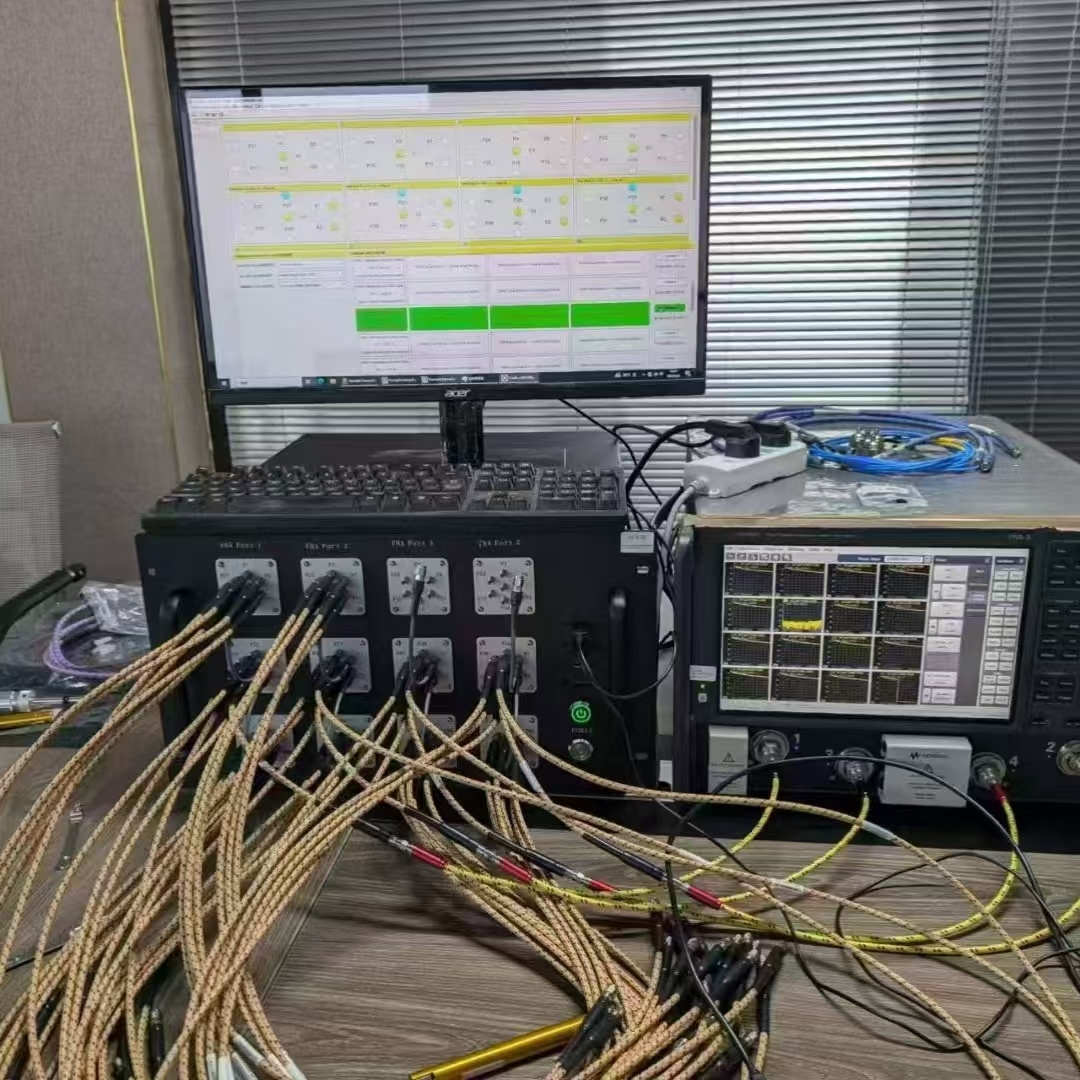


E5071B ENA Radio Frequency Network Analyzer, 300 kHz to 8.5 GHz
Category:
Desktop network analyzer
Network analyzer
Product Attachment:
- Product Description
- Selection
-
- Brand: 是德科技
- Commodity name: E5071B ENA Radio Frequency Network Analyzer, 300 kHz to 8.5 GHz
- Brand: Keysight Technologies
Keysight E5071B Network Analyzer: An efficient and precise choice for RF testing
I. Product Positioning and Core Value
II. Core Technical Indicators and Performance Advantages
(1) Frequency Range
(2) Dynamic Range
(3) Scan Speed
(4) Trace Noise
III. Functional Characteristics and Innovative Design
(1) Multi-port Integration and Balanced Measurement
- Flexible Port Configuration The E5071B integrates 2, 3, and 4 ports. Users can flexibly choose the number of ports according to their actual measurement needs. For simple single-port or dual-port devices, the 2-port mode can be used for measurement; for more complex multi-port networks, such as mobile phone front-end modules, the 4-port mode can simultaneously measure all signal paths, obtaining comprehensive network parameters at once and greatly improving testing efficiency.
- Balanced Measurement Function The instrument has a built-in balanced measurement function, which can be used to test balanced components such as SAW filters, differential amplifiers, and high-speed digital cables/connectors. During balanced measurement, it can effectively separate common-mode and differential-mode signals and accurately measure mixed-mode S-parameters, providing detailed and accurate data support for the design and optimization of balanced circuits.
(2) Fixture and Impedance-related Functions
- Fixture Embed/De-embed It has a fixture embed/de-embed function. In actual tests, the test fixture will introduce some errors into the measurement results. Through this function, the instrument can compensate for the influence of the fixture, eliminating the loss and reflection caused by the fixture and restoring the true performance of the device under test to ensure the accuracy of the measurement results.
- Port Characteristic Impedance Conversion It supports port characteristic impedance conversion and can flexibly adjust the impedance matching of the instrument port according to the characteristic impedance requirements of the device under test. For example, for some devices that require 50Ω or 75Ω impedance matching, the E5071B can easily achieve the corresponding impedance setting, ensuring the integrity of the signal during transmission and avoiding signal reflection and measurement errors caused by impedance mismatch.
(3) Frequency Offset Mode
(4) Built-in Programming Language and Automation
- Built-in Visual Basic® for Applications (VBA) It has a built-in VBA programming environment. Users can use the powerful programming functions of VBA to develop automated test programs according to their specific test needs. By writing code, the automated control of the instrument can be realized, such as automatically setting measurement parameters, starting measurement, data acquisition and analysis, etc., greatly improving testing efficiency and the accuracy of data processing, especially suitable for scenarios that require a large number of repetitive tests.
- Measurement Wizard Assistant (MWA) Software It is equipped with Measurement Wizard Assistant software, which provides users with an intuitive and convenient operating interface. Even engineers who are not very familiar with the operation of network analyzers can quickly complete complex measurement settings through the guidance in the software and easily start various RF measurement work, reducing the threshold of instrument use and improving work efficiency.
IV. Typical Application Scenarios
(1) Communication Field
- Base Station RF Module Testing In base station construction, the performance of the base station RF module directly affects communication quality. The E5071B can be used to measure the S-parameters, impedance matching, and other performance indicators of key components such as filters, power amplifiers, and duplexers in base station RF modules. By accurately measuring these parameters, engineers can evaluate the performance of the RF module, promptly identify and solve potential problems, and ensure that the base station equipment can operate stably and efficiently, providing users with high-quality communication services.
- Mobile Phone RF Front-End Testing In the mobile phone production process, the performance of the radio frequency front-end plays a decisive role in the communication capabilities of the mobile phone. Using the multi-port measurement function of the E5071B, multiple devices in the mobile phone's radio frequency front-end module, such as antenna switches, low-noise amplifiers, and radio frequency filters, can be jointly tested to comprehensively evaluate the overall performance of the radio frequency front-end. Simultaneously, through the balance measurement function, it is possible to accurately analyze the performance of the differential signal chain, optimize the design of the mobile phone's radio frequency front-end, and improve the mobile phone's signal receiving and transmitting capabilities.
(II) Electronic Equipment Manufacturing
- Wireless Module Testing For Bluetooth, Wi-Fi, NFC, and other wireless modules, the E5071B can measure key performance indicators such as transmission power, receiving sensitivity, and out-of-band radiation. By accurately measuring these parameters, manufacturers can ensure that wireless modules comply with relevant standards and specifications, improve product quality, and enhance product competitiveness in the market. For example, in Bluetooth module production, measuring transmission power and receiving sensitivity can ensure stable communication distance and data transmission reliability between Bluetooth devices.
- Radio Frequency Circuit Debugging In the research and development and production of radio frequency circuits, engineers need to debug and optimize various radio frequency devices in the circuit. The E5071B, with its fast scanning speed and high-precision measurement capabilities, can help engineers quickly locate problems in the circuit, such as impedance mismatch and signal leakage. By monitoring and analyzing measurement data in real time, engineers can make targeted adjustments to the circuit, shortening product development cycles and improving production efficiency.
(III) Scientific Research and Education
- University Research Projects In university research projects related to electronic information and communication engineering, the E5071B can be used to study the performance of new radio frequency devices and circuits. For example, when researching the design of new microwave filters, by measuring the S-parameters of the filter and analyzing its frequency response, insertion loss, in-band fluctuation, and other performance indicators, data support is provided for the optimized design of the filter, promoting the progress of research projects.
- Experimental Teaching In experimental teaching, the E5071B provides students with an intuitive and accurate radio frequency measurement tool. Students can use this instrument to gain a deeper understanding of the basic principles of radio frequency circuits and master the measurement methods and techniques of radio frequency devices. For example, in S-parameter measurement experiments, students can observe the impact of different parameter settings on the measurement results through practical operations, deepening their understanding of radio frequency measurement concepts and cultivating practical operation capabilities and scientific research thinking.
V. User Value and Industry Impact
(I) Improved Testing Efficiency
(II) Ensuring Measurement Accuracy
(III) Lowering the Technical Barrier
-
- 008 Frequency offset mode.
- 010 Time domain analysis function.
- 015 Standard color LCD display.
- 016 Touch screen color LCD display.
- 0bw Service documentation, assembly level.
- 1a7 ISO 17025 compliant calibration.
- 1cm Rack mounting kit.
- 1cn Handle kit.
- 1cp Rack mounting and handle kit.
- 1e5 Add high stability time base (remove unq).
- 213 2-port S-parameter test set, standard power range (-15dBm to 10dBm).
- 214 2-port S-parameter test set, extended power range (-50dBm to 10dBm).
- 313 3-port S-parameter test set, standard power range (-15dBm to 10dBm).
- 314 3-port S-parameter test set, extended power range (-50dBm to 10dBm).
- 413 4-port S-parameter test set, standard power range (-15dBm to 10dBm).
- 414 4-port S-parameter test set, extended power range (-50dBm to 10dBm).
- 790 Measurement wizard software.
- 810 Add keyboard.
- 820 Add mouse.
- a6j ANSI Z540 compliant calibration with test data.
- ab1 Korea Quick Start Guide (Korean localization).
- ab2 China Quick Start Guide (Chinese localization).
- aba USA Quick Start Guide (English localization).
- abd Germany Quick Start Guide (German localization).
- abe Spain Quick Start Guide (Spanish localization).
- abf France Quick Start Guide (French localization).
- abj Japan Quick Start Guide (Japanese localization).
- abz Italy Quick Start Guide (Italian localization).
- ato ENA Series Network Analyzer, 300kHz to 8.5GHz - ATO model.
- uk6 Commercial calibration with test results data.
- unq Standard stable time base.
Product Consultation
Please fill out the form below, leave your contact information and needs, and we will be happy to serve you!
Contact Information
Add.: 2nd Floor, Building C, Zhongzhi Zhichuang Park, Yucui Community, Longhua Street, Longhua District, Shenzhen City, Guangdong Province, China
Tel: +86-135 1042 6680
Email: harriosn@sengt.com
Follow us

Follow us