
-
High-frequency measurement system services Material testing Probe station Microwave anechoic chamber/shielded roomLan Cable Fully Automatic Tester Auto Switch fully automatic testing machine USB 4 / Type-C finished product line test system DisplayPort 2.1 finished product line test system HDMI 2.1 finished product line test system MCIO finished product line testing system Gen-Z finished product line testing system PCIE finished product line test system OCuLink Finished Product Line Test System QSFP/SFP finished product line test system HSD finished product line test system FAKRA finished product line testing system SAS/MiniSAS/SlimSAS Finished Product Line Testing System Raw Cable 20G/40G/50G Bare Wire Test System SATA/eSATA finished product line test system LVDS finished product line testing system Pre-test Integration ProjectElectromagnetic shielding test system Material electromagnetic parameter testing system Resistivity testing system Cable Shielding Effectiveness Test System Conductive gasket shielding effectiveness test system Reflection rate test system for absorbing materials NSS Noise Suppression/Absorption Sheet Performance Evaluation System Pre-compatibility testing systemUltra-low temperature vacuum probe station Automated probe station Manual probe station Displacement platform
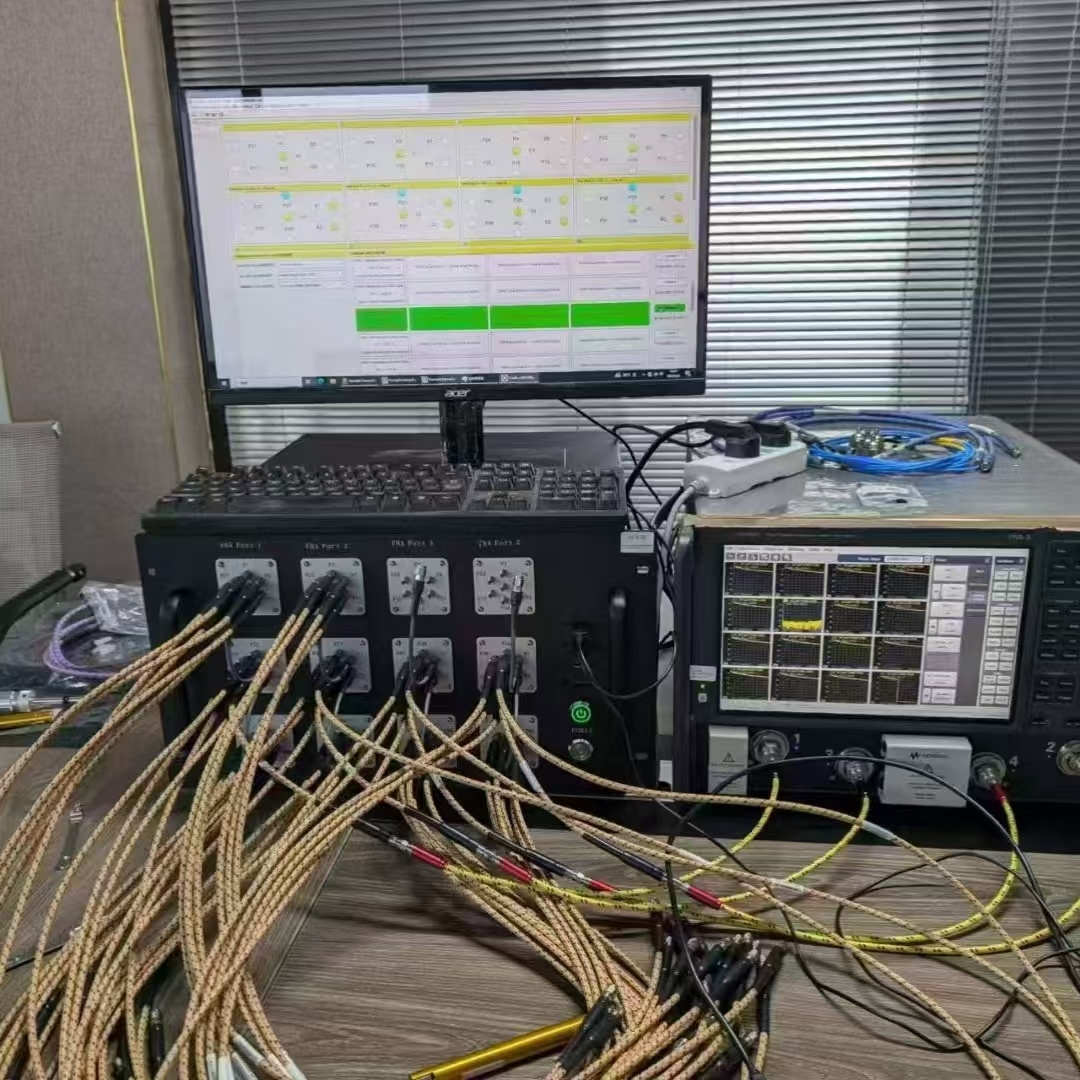


N5239A PNA-L Microwave Network Analyzer, 8.5 GHz
Category:
Network analyzer
Desktop network analyzer
Product Attachment:
- Product Description
- Selection
-
- Brand: 是德科技
- Commodity name: N5239A PNA-L Microwave Network Analyzer, 8.5 GHz
- Brand: Keysight Technologies
Authoritative Analysis: Keysight N5239A PNA-L Microwave Network Analyzer
I. Core Positioning and Technical Parameters (Based on Official Website and Authoritative Data)
II. Typical Application Scenarios and Adaptability Analysis
- Passive Component Testing :
- S-parameter measurement of filters (such as 5G Sub-6GHz bandpass filters), couplers, and power dividers.
- Frequency response analysis of dielectric resonators (DRO) (accuracy up to 0.01Hz).
- Simple Active Component Evaluation :
- Gain flatness of low-noise amplifiers (LNA) (e.g., gain fluctuation <0.5dB for 6GHz Wi-Fi modules).
- Conversion loss and port isolation test of mixers (e.g., LO-IF isolation >30dB).
- Material and Cable Characterization :
- Insertion loss (e.g., loss <0.5dB/m at 8.5GHz) and voltage standing wave ratio (VSWR <1.2) measurement of RF cables.
- Extraction of complex permittivity of dielectric materials (such as FR4 substrates) (through reflection/transmission method).
- Cannot cover millimeter-wave frequency bands (such as above 24GHz); 76-81GHz automotive radar testing requires upgrading to N5240A or higher models.
- If expansion to millimeter wave is required, an external down-conversion module (such as the 11970V series) can be used, but this will introduce additional loss (e.g., >3dB at 20GHz).
III. Key Considerations for High-Frequency Testing
- Standard Interface N-type (50Ω); above 20GHz requires upgrading to a 3.5mm connector (such as option 001).
- Calibration Fixture Selection :
- Below 8.5GHz: Use the 125A series N-type calibration fixture (covering 10MHz-18GHz).
- If an external module is used to expand to 20GHz: Requires a 3.5mm precision calibration fixture (such as 125B-265).
- Electronic Calibration (ECal) Achieves fast calibration (<30 seconds) through the 85032E module, reducing manual calibration errors (such as directivity error <0.05dB).
- Temperature Stability It is recommended to test at 23±2℃ to avoid temperature drift causing measurement fluctuations (e.g., 0.01dB amplitude error caused by 1℃ drift).
- For higher frequency or extended functionality, consider upgrading to N5239B (8.5GHz, supports touchscreen and automated testing) or N5222A (9kHz-20GHz, supports vector signal analysis).
IV. Discontinuation and Support Status
- The N5239A entered the "limited support" phase in June 2024, and repair and calibration services are gradually being reduced.
- Keysight Technologies recommends Hardware/Firmware Upgrade Plan Migrating to the B model, the cost is only 30-50% of the new product.
- Fully compatible with the N5230C; existing test codes and fixtures can be reused directly, protecting users' existing investments.
V. Summary: Selection Decision Reference
- Recommended Scenarios :
- University laboratories or small and medium-sized enterprise R&D with limited budgets.
- Mass production testing of Sub-6GHz RF components (such as filters, antennas).
- Preliminary evaluation of simple active devices (such as LNAs, mixers).
- Pitfalls to Avoid :
- Avoid use for testing above 8.5GHz (such as 5G millimeter wave).
- High-frequency testing requires low-loss cables (such as 85133D-265) and high-precision calibration components to ensure system error <0.1dB.
-
I. Hardware Options and Basic Configuration
1. Frequency Range and Port Characteristics
- Basic Model: 2-port, covering 300 kHz to 8.5 GHz, suitable for S-parameter measurements of low-loss components (e.g., filters, antennas).
- Dynamic Range: Up to 133 dB at 20 GHz, trace noise as low as 0.004 dB rms (1 kHz IFBW), supporting high-precision low-loss testing.
- Output Power: Extended power range from -55 to +13 dBm, built-in 60 dB step attenuator, suitable for linear/nonlinear characteristic analysis of active devices such as amplifiers.
2. Calibration and Accessories
- Mechanical Calibration Kits:
- 85052D: 3.5 mm calibration kit, covering 300 kHz to 20 GHz, supports SOLT calibration.
- 85052D-001: 2.4 mm calibration kit, suitable for high-frequency testing (e.g., 40/50 GHz extension).
- Electronic Calibration (ECal) Module: N4691A, single-connection fast calibration, supports 2 ports, reduces manual operation errors.
- Test Cable: 85131F, 3.5 mm flexible test cable, suitable for 300 kHz to 20 GHz band, ensures signal integrity.
3. Functional Expansion Options
- -010 Time Domain Measurement: Supports pulse signal analysis (e.g., dynamic response of radar modules), pulse width as low as 2 μs.
- -1CP Rack Mount Kit: Adapts to standard 19-inch cabinets, improving production line integration.
- -216 Configurable Test Set: Integrates power attenuators, simplifying automated testing of complex RF links.
- -UK6 Calibration Certificate: Provides official calibration report with test data, meeting quality certification requirements.
II. Software Functions and Application Scenarios
1. Advanced Measurement Functions
- Fixture De-embedding: Eliminates test fixture effects through TRL/LRM calibration, suitable for high-precision measurements of wafer-level and packaged devices.
- Mixer/Converter Testing: Built-in wizard automatically measures conversion loss, local oscillator (LO) leakage, and other parameters, simplifying RF front-end design verification.
- Multi-mode Scan: Supports linear/log/power sweeps, adapting to the testing requirements of different devices such as filters, antennas, and amplifiers.
2. Automation and Compatibility
- Built-in VBA Programming: Customize test scripts, batch execute multi-port S-parameter sweeps, data storage, and report generation.
- Spectrum Analysis Function: Integrates a spectrum analyzer via option -090, enabling combined analysis of signal integrity and frequency domain characteristics.
3. Typical Applications
- Wireless Communication:
- Test S-parameters of Wi-Fi 6E antennas, RF front-end modules, and verify signal integrity with time-domain options.
- Evaluate in-band loss and out-of-band rejection characteristics of 5G IF filters.
- Materials and Semiconductors:
- Analyze dielectric constant and loss characteristics of high-frequency substrates (e.g., FR4, PTFE), supporting TRL calibration.
- Perform on-chip component (e.g., RF transistor) S-parameter testing in conjunction with a wafer probe station.
- Education and R&D:
- Basic RF teaching experiments (e.g., Smith chart analysis, impedance matching).
- Development of low-cost solutions, suitable for budget-sensitive laboratory environments.
III. Discontinuation Status and Replacement Suggestions
- For higher integration and operational convenience, choose N5239B, which supports an intuitive graphical interface and fast calibration process.
- If frequency extension to 13.5 GHz is needed, N5231B is the better choice, and it is compatible with existing test fixtures and scripts.
IV. Configuration Suggestions
- Basic RF Testing: Option -010 (Time Domain Measurement) + 85052D Calibration Kit + N4691A ECal Module.
- Material Analysis: Option -010 + 85052D-001 High-Frequency Calibration Kit + Dielectric Test Fixture (e.g., Keysight 16453A).
- Automated Production Line: Option -1CP (Rack Mount) + -216 (Configurable Test Set) + Customized VBA Scripts.
Previous Page
Product Consultation
Please fill out the form below, leave your contact information and needs, and we will be happy to serve you!
Contact Information
Add.: 2nd Floor, Building C, Zhongzhi Zhichuang Park, Yucui Community, Longhua Street, Longhua District, Shenzhen City, Guangdong Province, China
Tel: +86-135 1042 6680
Email: harriosn@sengt.com
Follow us

Follow us