
-
High-frequency measurement system services Material testing Probe station Microwave anechoic chamber/shielded roomLan Cable Fully Automatic Tester Auto Switch fully automatic testing machine USB 4 / Type-C finished product line test system DisplayPort 2.1 finished product line test system HDMI 2.1 finished product line test system MCIO finished product line testing system Gen-Z finished product line testing system PCIE finished product line test system OCuLink Finished Product Line Test System QSFP/SFP finished product line test system HSD finished product line test system FAKRA finished product line testing system SAS/MiniSAS/SlimSAS Finished Product Line Testing System Raw Cable 20G/40G/50G Bare Wire Test System SATA/eSATA finished product line test system LVDS finished product line testing system Pre-test Integration ProjectElectromagnetic shielding test system Material electromagnetic parameter testing system Resistivity testing system Cable Shielding Effectiveness Test System Conductive gasket shielding effectiveness test system Reflection rate test system for absorbing materials NSS Noise Suppression/Absorption Sheet Performance Evaluation System Pre-compatibility testing systemUltra-low temperature vacuum probe station Automated probe station Manual probe station Displacement platform
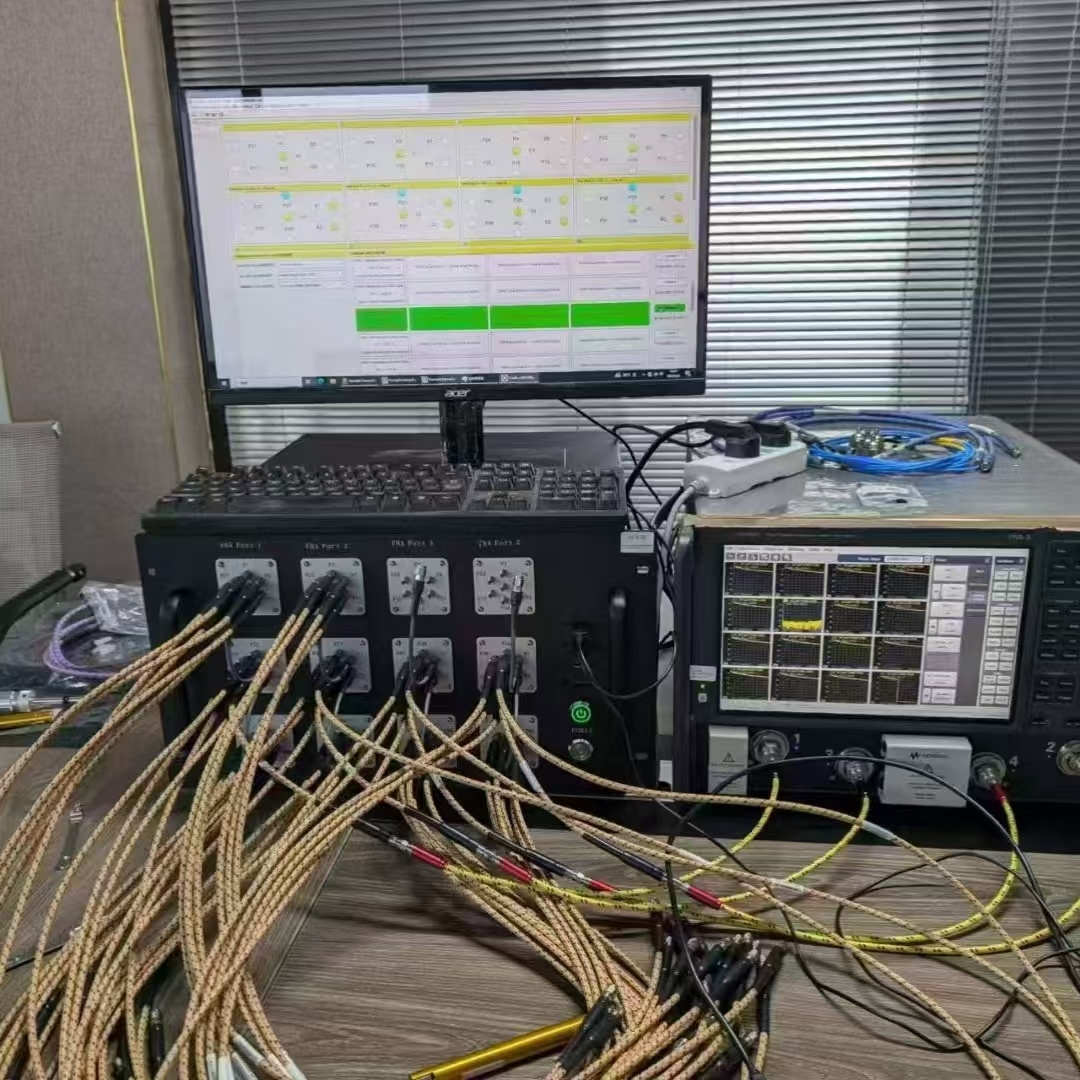


N5244A PNA-X Microwave Network Analyzer, 10MHz-43.5GHz
Category:
Network analyzer
Desktop network analyzer
Product Attachment:
- Product Description
- Selection
-
- Brand: 是德科技
- Commodity name: N5244A PNA-X Microwave Network Analyzer, 10MHz-43.5GHz
- Brand: Keysight Technologies
The 5244A vector network analyzer, meticulously crafted by Keysight (formerly part of Agilent), is a high-performance device holding a significant position in the RF and microwave testing field. With its advanced technical specifications and powerful functionalities, it is widely used in cutting-edge fields such as wireless communication, radar, antenna design, and materials research. I. Outstanding Technical Specifications - Ultra-wide Frequency Coverage With an ultra-wide frequency range of 10MHz to 43.5GHz, it seamlessly covers numerous important communication bands. Whether it's low-frequency 2G/3G/4G networks, high-frequency 5G networks, or millimeter-wave applications, the N5244A can easily handle them all, fully meeting the stringent testing needs of various RF and microwave devices.
- Powerful Dynamic Range Boasting a receiver dynamic range of up to 129dB, it can accurately capture extremely weak signals while effectively distinguishing signals of different strengths, ensuring accurate and reliable measurement data even in complex testing environments.
- High Output Power and Low Harmonics With an output power of up to +16dBm, it provides strong test signal excitation; harmonic distortion as low as -60dBc ensures high purity of the output signal, greatly reducing the impact of signal interference on measurement results and laying a solid foundation for high-precision testing.
- Abundant Measurement Points and Channels Supporting up to 32,001 measurement points and 200 channels, it allows for detailed and comprehensive analysis of complex RF networks, leaving no detail overlooked and helping engineers gain a deep understanding of device performance.
II. Diverse Functional Features - Built-in Dual Signal Sources The analyzer is equipped with two built-in signal sources. This unique design greatly facilitates the testing process, enabling easy implementation of various complex test scenarios and significantly improving testing efficiency and accuracy.
- Multi-parameter Measurement Capability It can not only accurately measure S-parameters (continuous wave and pulse modes), but also simultaneously measure key parameters such as noise figure, gain compression, intermodulation distortion, harmonic distortion, and conversion gain/loss, providing a one-stop solution for comprehensive device performance evaluation.
- Time-domain and Frequency-domain Analysis It has time-domain analysis capabilities. By performing an inverse Fourier transform on the frequency-domain data, it can intuitively obtain the time-domain response, helping engineers quickly locate and analyze discontinuities and reflection problems in devices, allowing for targeted optimization and improvement.
III. Wide Range of Applications - Wireless Communication Field In the research and production of wireless communication technologies such as 5G base station construction and Wi-Fi 6E, the N5244A plays an indispensable role. It can perform comprehensive performance testing on key components such as RF front-end modules, filters, and antennas, ensuring that these components fully meet relevant communication standards and specifications, providing strong support for building high-speed and stable wireless communication networks.
- Radar and Antenna Design In the research and development of radar systems and antenna design, the N5244A can be used to test various performance parameters of radar antennas, such as gain, directivity, and beamwidth, and to accurately evaluate the linearity and noise performance of radar RF components, helping to improve the detection accuracy and reliability of radar systems.
- Semiconductor and Materials Research In semiconductor chip manufacturing and the research of new microwave materials, this analyzer can perform detailed testing on on-chip RF devices and packaged RF modules, accurately extracting the high-frequency parameters of the devices, helping researchers gain a deep understanding of the electromagnetic characteristics of materials, and providing key data support for optimizing chip design and material performance.
With its outstanding performance, rich features, and wide applicability, the N5244A vector network analyzer has become the preferred tool in the RF and microwave testing field, making significant contributions to technological innovation and development in related industries. -
Options Use Cases 008 - Pulsed RF Measurement Used for measuring pulsed radio frequency signals, such as pulsed S-parameters, pulsed power, and pulse envelopes. Suitable for testing radio frequency pulsed devices, such as pulsed amplifiers and pulse modulators. 。 010 - Time Domain Measurement Performs time-domain related measurements, such as analyzing signal characteristics in the time domain. Helpful for researching transient responses, pulse shape analysis, and fault location. For example, in high-speed circuit signal integrity analysis, it can be used to view time-domain characteristics such as signal rise and fall times. 020 - Add IF Input Used when connecting to an intermediate frequency (IF) signal for measurement or for connecting and cooperating with other devices with IF output for testing, such as with IF modulators/demodulators and IF amplifiers, for analysis and testing of IF signals. 021 - Add Pulse Modulator to Internal First Source If the first internal signal source needs pulse modulation to generate pulse-modulated signals for testing the performance of devices under pulse excitation, such as testing the response of pulse-driven amplifiers and mixers to pulse-modulated signals. 022 - Add Pulse Modulator to Internal Second Source Similar to 021, but adds pulse modulation to the second internal signal source. Useful for more complex dual-source pulse testing scenarios. For example, in testing nonlinear devices that require excitation by two different pulse signals, pulse modulation can be applied to both sources to simulate actual operating conditions. 025 - Add Four Internal Pulse Generators Provides four additional internal pulse generators that can produce various pulse signals to meet the testing needs of multi-channel and multi-pulse excitation. For example, in multiple-input and multiple-output (MIMO) system testing and complex pulse sequence testing scenarios, these pulse generators can precisely control pulse parameters and timing. 028 - Noise Figure Measurement Using Standard Receiver Used to measure the noise figure of a device or system using a standard receiver. The noise figure is an important indicator of the internal noise performance of radio frequency devices or systems. In the research and production testing of amplifiers and receivers, accurate measurement of the noise figure is needed to evaluate performance. 029 - Corrected Noise Figure Measurement to 50 GHz Performs corrected noise figure measurements over a wider frequency range (up to 50 GHz). Compared to standard noise figure measurement options, it provides more accurate noise figure measurement results at higher frequencies, suitable for noise performance evaluation of high-frequency microwave devices and systems. 080 - Frequency Offset Measurement Used to measure the frequency offset of a signal. Useful in applications requiring precise measurement of frequency changes, such as in the study of frequency modulation devices, phase-locked loop circuits, and analysis of the frequency stability of radio frequency signals, accurately measuring the frequency offset. 082 - Scalar Calibration Converter Measurement Primarily used for measurements related to scalar calibration converters. Suitable for measurement scenarios where only signal amplitude information is needed, and phase information is not required, such as simple power measurement and attenuation measurement. Scalar calibration improves the accuracy of amplitude measurement. 083 - Vector and Scalar Calibration Converter Measurement Performs both vector calibration (considering both amplitude and phase information) and scalar calibration converter measurements. Suitable for scenarios with high measurement accuracy requirements, where both accurate amplitude and phase information are needed. For example, in complex radio frequency circuit design and testing, where both signal amplitude and phase have strict requirements, this option provides comprehensive calibration and measurement functions. 084 - Embedded LO Measurement Used for measuring embedded local oscillators (LO). In the testing of devices or systems containing mixers, frequency converters, etc., that require local oscillator signals, the embedded local oscillator signal can be measured and analyzed. For example, measuring parameters such as the frequency, power, and phase noise of the local oscillator to ensure the accuracy and stability of the mixing or frequency conversion process. 086 - Gain Compression Measurement Specifically used to measure the gain compression characteristics of a device or system. In the testing of radio frequency amplifiers, when the input power increases to a certain level, the gain of the amplifier will be compressed. This option accurately measures the gain compression point and gain changes at different input powers, which is very important for evaluating the linear operating range and power handling capability of the amplifier. 087 - Intermodulation Distortion Measurement Used to measure intermodulation distortion products generated after a signal passes through a device or system. In the testing of multi-carrier communication systems and radio frequency power amplifiers, intermodulation distortion can lead to signal quality degradation and spectrum pollution. This option analyzes the degree and characteristics of intermodulation distortion to allow for optimization and improvement. 088 - Source Phase Control Allows for precise control of the signal source phase. Essential in testing scenarios requiring precise phase matching and control, such as in coherent communication system testing and antenna array testing. Control of the signal source phase is used to achieve coherent signal synthesis or beamforming. 118 - Fast CW Mode Provides a fast continuous wave (CW) mode to speed up continuous wave signal measurements. In scenarios requiring a large number of continuous wave measurements, such as quickly scanning continuous wave signals at multiple different frequency points or performing rapid continuous wave performance tests on a large number of devices on a production line, it significantly improves testing efficiency. 1A7 - Calibration + Uncertainty + Guard Plate Includes calibration-related functions and assessment of measurement uncertainty, and may provide a protective plate to enhance instrument safety or stability. The calibration function ensures measurement accuracy, while uncertainty assessment allows users to understand the reliability of the measurement results. Suitable for scientific research and metrology applications with high requirements for measurement accuracy and reliability. 1CM - Rack mounting kit without handle Used to mount the instrument on a standard rack, facilitating integration and management within the equipment rack. Suitable for system integration scenarios where the N5244A needs to be installed in a standard rack with other equipment. The handle-less design may be more suitable for some space-constrained environments or where a handle is not required. 1CP - Rack mounting kit with handle Similar to 1CM, it is also a rack mounting kit, but with a handle for easy operation during installation and removal of the instrument. Suitable for scenarios requiring easier operation of the instrument, such as in laboratories where the instrument needs to be frequently moved or adjusted. 200 - 2-port, single source Configures the instrument to a 2-port, single-source mode. Suitable for scenarios where only two ports are needed for simple measurements and dual-source excitation is not required, such as basic S-parameter measurements of simple two-port network components (e.g., filters, attenuators). 219 - Adds extended power range and bias tee to the 2-port analyzer If you need to extend the power range and use a bias tee to provide a DC bias signal in a 2-port analyzer application, you can choose this option. For example, when testing some RF devices that require a specific DC bias (such as transistor amplifiers), a bias tee can provide the appropriate DC bias, while extending the power range to meet the testing needs of different power levels. 400 - 4-port, dual source Configures the instrument to a 4-port, dual-source mode. Suitable for more complex testing scenarios requiring four ports for simultaneous measurement and dual-source excitation, such as in multi-port network analysis and complex RF system integration testing, where four ports and two signal sources can be used for comprehensive performance evaluation. 419 - Adds extended power range and bias T to the 4-port analyzer Similar to option 219, but for 4-port analyzers. In 4-port testing scenarios, if you need to extend the power range and use a bias T to provide DC bias, you can choose this option. For example, when testing multi-port active devices or systems, provide appropriate DC bias and extended power range for each port to meet different testing requirements. 423 - Adds internal combiner and mechanical switch to the 4-port analyzer Adds an internal combiner and mechanical switch to the 4-port analyzer, enabling more flexible signal routing and combining functions. Suitable for complex testing scenarios requiring the combination, distribution, or switching of multiple signals, such as in multi-channel RF system testing, where the internal combiner and mechanical switch can easily achieve connection and switching between different channels for performance testing under various combinations. 510 - Nonlinear component characterization, full frequency range Used to characterize nonlinear components across the full frequency range. In the research and design of RF nonlinear devices (such as power amplifiers and mixers), it is necessary to fully understand their nonlinear characteristics at different frequencies. This option provides nonlinear characterization capabilities across the full frequency range, from low to high frequencies, helping engineers accurately analyze and optimize the performance of nonlinear devices. 514 - Nonlinear x-parameters Specifically used for measuring and analyzing the x-parameters of nonlinear devices. X-parameters are a set of parameters used to describe the behavior of nonlinear devices. Compared with traditional methods such as S-parameters, they can more comprehensively and accurately describe the characteristics of nonlinear devices under large-signal excitation. Suitable for scenarios requiring precise modeling and analysis of nonlinear devices, such as in the design and optimization of RF power amplifiers, where measuring x-parameters can better understand the nonlinear behavior of the amplifier, thus enabling more effective linearization design. 518 - Nonlinear pulse envelope domain Used for analysis and measurement of devices or systems in the nonlinear pulse envelope domain. In some complex testing scenarios involving pulse signals and nonlinear characteristics, such as the analysis of the nonlinear behavior of pulse power amplifiers under pulse excitation, this option provides specialized measurement and analysis functions to help users gain a deeper understanding of the characteristics of nonlinear devices in the pulse envelope domain. 520 - Arbitrary load impedance x-parameters Can measure and analyze the x-parameters of nonlinear devices under arbitrary load impedance conditions. In actual RF circuit design, load impedance is often diverse. This option can meet the needs of accurate characterization of nonlinear devices under different load impedance conditions. For example, when designing matching networks or evaluating the performance of devices in different load environments, measuring x-parameters under arbitrary load impedance can provide a more comprehensive understanding of the device's behavior and performance changes.
Previous Page
Product Consultation
Please fill out the form below, leave your contact information and needs, and we will be happy to serve you!
Contact Information
Add.: 2nd Floor, Building C, Zhongzhi Zhichuang Park, Yucui Community, Longhua Street, Longhua District, Shenzhen City, Guangdong Province, China
Tel: +86-135 1042 6680
Email: harriosn@sengt.com
Follow us

Follow us